Showing posts with label work. Show all posts

Wednesday, November 19, 2014

Thoughts on #ShirtStorm – Standing Beside Women in Science

Last week a man, Dr Matt Taylor of ESA, made a mistake. The mistake was pointed out to him by other scientists, both men and women. He apologised. We moved on.

Except, we weren’t allowed to move on.

The act of pointing out the mistake made brought down waves of opprobrium on the women (and, curiouslynotcuriously, almost entirely on the women) who did so, from all over the internet. A sickening display of male condemnation from the likes of the Daily Mail, Boris Johnson and others in the Telegraph, and Prof. Richard Dawkins on Twitter helped rouse the sexist rabble. Specious arguments were made, and are still being made, as to why wearing That Shirt wasn’t wrong and Taylor shouldn’t have ‘been forced’ to apologise.
I’m going to address many of the points here. Let me be clear that this is not a personal attack on Taylor, he has already accepted responsibility for his action and apologised. This is about sexism more generally, and the trolling on #ShirtStorm in particular.

Let's take this from the top.

Taylor made a mistake. This is easy enough to do; he was, like almost all people, raised in a society where casual sexism - microaggressions - are accepted as part of the culture. I don’t know Taylor, but from the accounts of people who do, he’s not a sexist. I have no reason to believe his apology wasn’t sincere, as is implied by those claiming he was forced to make it, and thus his breaking down in tears was caused not by being forced to make this apology against his will but by the realisation that he had let himself down, let ESA down, and let science down. Those who are ‘defending’ Taylor, claiming his right to wear the shirt and damn the consequences, are effectively calling him a liar.

What about the right to free speech?
Free speech means you have the right, as a private citizen, to say anything (within certain restrictions, normally including incitement to hatred/violence/criminal acts) without the government punishing you for that speech. A common misunderstanding is that this means nobody can censure you. This has been shown time and again to be untrue - if you say something that embarrasses your employer, they are quite free to take disciplinary action or fire you. This normally applies when speaking as an employee - either in the workplace or as a spokesperson, but for well-known figures (including community figures such as teachers or policemen, for example) it could apply to speech made anywhere. (As an aside, this was one of the reasons for academic tenure - it meant academics cannot be sacked for taking unpopular stances.)
Free speech most obviously does not apply in the workplace, where rules on harassment place limits on what can be said. This includes not just overtly sexist actions, but “creating … an offensive environment” (quote from Acas guidance). Wearing the shirt was creating an offensive environment. Intent is unimportant, it’s the effect that’s important (this is a legal principle, not just something I’m saying). Had it been part of a pattern of behaviour, wearing that shirt would have constituted harassment (to be clear, I’ve not heard any claims that it was part of a pattern of behaviour).
Furthermore, Taylor was not simply at work, or even just representing his employer. He was on the world stage, representing astronomy. In this situation, free speech is not relevant - there is an expectation that someone in such a position will give an accurate account of what’s happening, behave in an audience-appropriate manner, and avoid giving offence, particularly to marginalised groups. It is amazing that nobody from ESA told him his shirt was inappropriate before he went in front of the cameras - ESA should be accepting some of the blame for this, but we have yet to hear an apology from them.

Was the shirt really that bad?
Yes, it was. We have a problem in astronomy (as in many other sciences) with women being underrepresented. This shirt presented an objectified, sexual view of women. The message it sent was ‘I value women for their bodies’. Unfortunately ours is a society where brainy women are considered unsexy, and sexy women brainless, so while a man may be considered both intelligent and sexy, the implication of ‘I value women for their bodies’ is ‘and not for their brains’. As a message sent out to millions across the world in the name of science, that really is not acceptable. This was summed up wonderfully on Twitter by science journalist Rose Eveleth: “No no women are toooootally welcome in our community, just ask the dude in this shirt”. For an in-depth discussion of this, see this article by Dr Zuleyka Zevallos.
 
Isn’t this distracting from the amazing achievement?
This may be surprising for the trolls, but most scientists are capable of holding two thoughts in their minds simultaneously (sometimes even more). We were all absolutely thrilled by the achievement of landing on a comet for the first time. I was in an important meeting with the NSF last Wednesday so couldn’t watch the live feed, but still found time to check the web periodically to see how things were going. I know that Dr Katie Mack - one of the woman scientists singled out by the Telegraph as having criticised Taylor - has appeared on the media multiple times talking about Rosetta and Philae (I also note that while Taylor was ‘Dr Taylor’ in the Telegraph, Mack was stripped of her title - another subtle microaggression and a clear breach of their own Style Book). I know that when I was answering questions at an event at Arecibo Observatory last weekend attended by over 1300 people, I got lots of questions about the landing and none about the shirt. There is simply no evidence that the shirt has distracted either astronomers or the public from celebrating the Rosetta team’s accomplishment. It seems the only ones who have been distracted are the trolls, who are so put out of joint by the idea of women having opinions that they can’t move on and insist on continuing to ‘discuss’ this.

So why are you writing this? Shouldn’t you be working?
Firstly, it’s a holiday in Puerto Rico today, so I’m not at work. Secondly, trolls have been harassing my professional colleagues for speaking out over an important issue. Thirdly, there’s this:
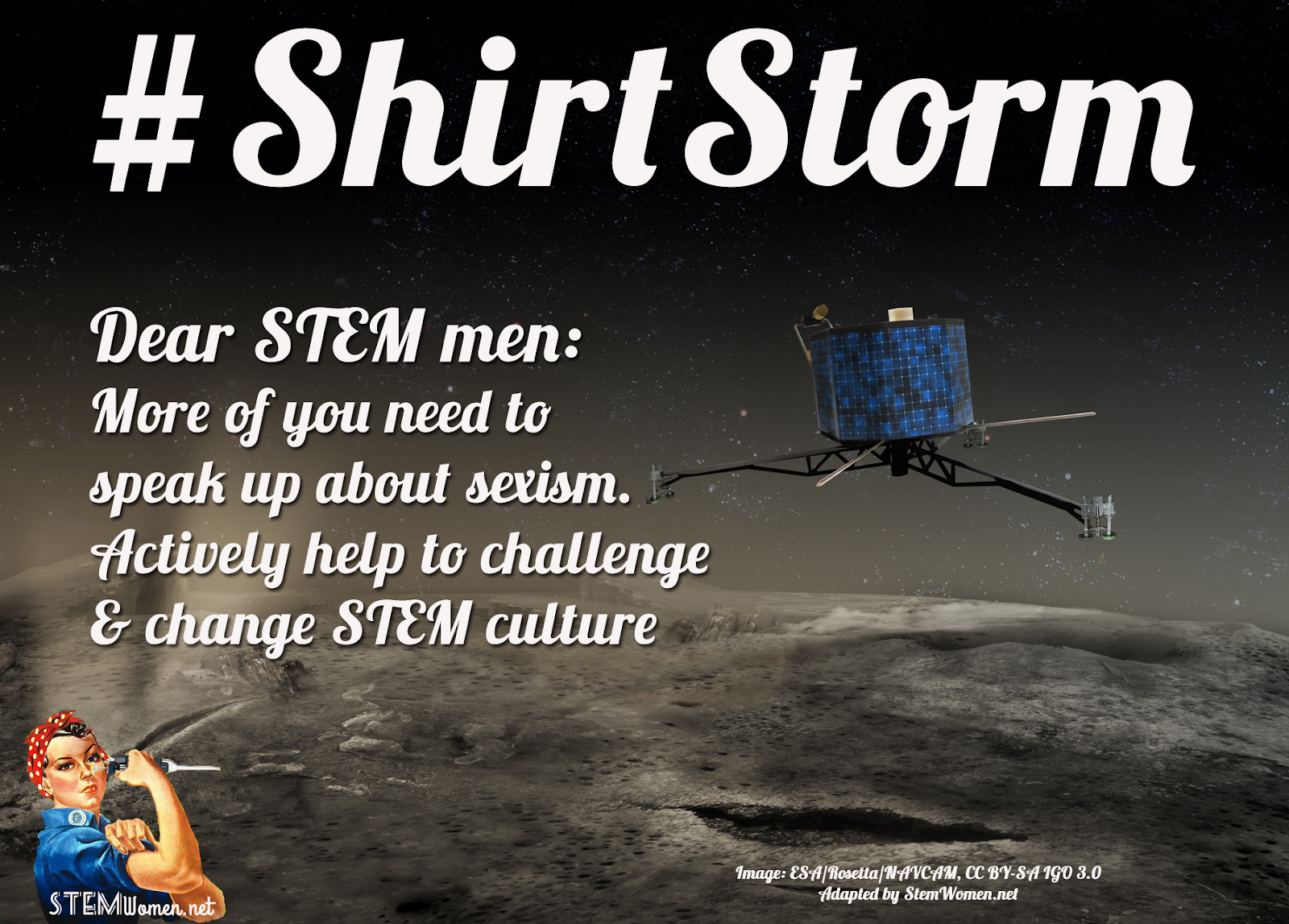
Why aren’t you writing about what Philae has discovered instead? Haven’t you more important things to do?
So important I could watch my colleagues being attacked and threatened and not do or say anything about it? I think not. Besides, I’m not a planetary scientist so have no scientific insights to add to the Philae story: anything I could say would merely be culled from the news reports.

Aren’t you just a Social Justice Warrior?
Yes. And proud of it.
I believe in ‘chwarae teg’ (‘fair play’ to those who don’t know Welsh). When I was growing up, this was considered a basic value of civilisation. But for some people, selfishness (as exemplified by Johnson and his chums from the Bullingdon Club) seems to have replaced it as a virtue. As Augustine of Hippo put it in De Civitate Dei way back in the 5th century: “Remota itaque iustitia quid sunt regna nisi magna latrocinia?” (“Without justice, what are kingdoms but great bands of robbers?”). Those who oppose social justice are the robbers who benefit from its absence.

Tuesday, March 18, 2014

A Dark Galaxy in the Virgo Cluster?

While updating my work website recently, I came across an old page on a dark galaxy candidate, VIRGOHI 21, that I had worked on back in 2004 - 2007. The page had not been updated since then, despite things having changed in the meantime. While updating it, I decided to write this blog post, giving some personal recollections and an explanation of my current thinking on the subject.
In 2005, I was first author on a paper about VIRGOHI 21 called “A Dark Hydrogen Cloud in the Virgo Cluster”. We had found the 'dark cloud' in a neutral hydrogen survey of the Virgo Cluster carried out a few years earlier with the Lovell Telescope at Jodrell Bank, and had already published initial results in an paper by Jon Davies the year before, “A multibeam HI survey of the Virgo cluster - two isolated HI clouds?”. The second cloud, VIRGOHI 27, was observed with the Giant Metrewave Radio Telescope in India and found to be a very faint galaxy, but deep optical images of the area of VIRGOHI 21 from the Isaac Newton Telescope in the Canary Islands did not show anything. Another oddity was that VIRGOHI 21 looked As if it was, like most galaxies, rotating - in observations with Arecibo we could see that the velocity changed from north to south. This made it look like a galaxy without any stars - a dark galaxy!
Isaac Newton Telescope image from our press release, the ellipse shows the extent of VIRGOHI 21 based on observations with Arecibo
We considered whether VIRGOHI 21 could be tidal debris. At that time, it was generally thought that the only way to form long streams was through slow, tidal interactions. We were able to rule this out as there was no large galaxy in the right position to have pulled VIRGOHI 21 into the shape we saw.
Sloan Digital Sky Survey image of VIRGOHI 21 from their Image of the Week gallery. The orginal caption reads: Radio telescopes at Arecibo and Jodrell Bank Observatory detect a large cloud of hydrogen gas at the center of the region of the sky covered by this image, but no corresponding objects can be seen in it. The rotation of this cloud indicates the presence of a significant mass of dark matter (matter that we cannot currently detect directly) as well.
The discovery led to headlines such as "Astronomers claim first 'dark galaxy' find" (New Scientist), "Astronomers find star-less galaxy" (BBC) and "Not even a twinkle out of galaxy with no stars" (The Times). VIRGOHI 21 even got its own entry in Wikipedia. But the story was far from over...
At the time the first paper was published, we were already planning high-resolution observations with the Westerbork Synthesis Radio Telescope in the Netherlands. We hadn't been able to detect VIRGOHI 21 with the Indian telescope earlier, but this time we saw it. These observations showed that VIRGOHI 21 was linked to a nearby galaxy, NGC 4254 by a bridge of hydrogen. This galaxy has an unusual, lopsided structure, with one very large spiral arm, and we had already discussed internally whether this could be linked to VIRGOHI 21 and dismissed the idea as something we did not have enough evidence to speculate on. Now we had the evidence.
We also had even deeper optical imaging from the Hubble Space Telescope that still failed to reveal any visible galaxy. The Hubble observations also answered an alternative scenario that some simulations suggested - a fast encounter that would rip gas out of NGC 4254 but would also, necessarily, pluck stars out of that galaxy and leave them floating freely in space in the same area as the gas. Had they been there, these stars would have been visible to Hubble - but we saw no evidence of them.
A three-colour (ir, and B bands) image of VIRGOHI 21 from the Isaac Newton Telescope overlaid with contours of neutral hydrogen density (green) from observations with the Westerbork Synthesis Radio Telescope. The extent of the galaxy is remarkably similar to the ellipse from the Arecibo data (above).
We published our Westerbork and Hubble results in a paper called “21-cm synthesis observations of VIRGOHI 21 - a possible dark galaxy in the Virgo Cluster”. At about the same time, the ALFALFA team published their map of VIRGOHI 21, which showed that the neutral hydrogen stream extended further to the north. This wasn't particularly shocking - seeing a 'leading arm' in front of an interacting galaxy is not uncommon.
Animation of the neutral hydrogen data cube from Westerbork. Up indicates increasing recessional velocity. VIRGOHI 21 is the structure in the centre, connected by a bridge to NGC 4254 (near the top of the image). The ring-like structure near the bottom of the image is NGC 4262.
Both the ALFALFA data and our Westerbork data were then used by a team in France who were modelling the system as a 'hyperbolic' interaction, a kind of cosmic 'hit and run' where another galaxy shot past NGC 4254 very quickly and then left the area before it could be identified. It may seem surprising that we gave our data freely to someone who were trying to prove us wrong - but that's the way science works!
The French team found that: “High-speed collisions, although current in clusters of galaxies, have long been neglected, as they are believed to cause little damages to galaxies except when they are repeated, a process called ‘harassment.’ In fact, they are able to produce faint but extended gaseous tails.” In other words, it was possible to explain VIRGOHI 21 as part of a tidal tail, formed from a high-speed galaxy encounter rather than the low-speed encounters we had considered.
While this did not absolutely rule out the hypothesis that VIRGOHI 21 was a dark galaxy, it presented a less exotic alternative - and as a general rule (known as Occam's Razor, after the medieval monk William of Ockham), the least exotic idea is considered the most likely explanation. But the simulations were far from being a great match to the observations, and further observations (unpublished) of the northern end of the stream showed it continuing at the same velocity as VIRGOHI 21 - more consistent with it being a leading arm than with the simulations. Could these simulations really explain VIRGOHI 21?
You're probably wondering why we didn't publish the new observations of the northern end of the stream, and point out the other inconsistencies between the simulations and the data. There are two reasons for this. The first is that while the simulations may not have been a great match to the data, they established the principle that it was possible to get long streams of neutral hydrogen via fast interactions. Once the stream was drawn out, there were many different forces acting within the cluster environment that could have altered its shape in myriad ways, so no simulation could be expected to provide an exact match.
The second reason is more complex, and is (to my mind) the most conclusive evidence against VIRGOHI 21. To understand this, it is necessary to go back to earlier in the story and look at predictions we made around the time the Arecibo surveys were starting up.
When we announced the Westerbork results, Jon Davies said in our press release that “We’re going to be searching for more Dark Galaxies with the new ALFA instrument at Arecibo Observatory. We hope to find many more over the next few years – this is a very exciting time!”
This wasn't just idle speculation - a year earlier we had published a paper, "The existence and detection of optically dark galaxies by 21-cm surveys", where we had argued that if VIRGOHI were a dark galaxy it implied the existence of many more dark galaxies. If these existed, they should be discovered by the next generation of neutral hydrogen surveys then getting started at Arecibo - and in large numbers. These dark galaxies would make up almost a quarter of the sources found in the deep AGES survey, while over a thousand would be seen by the shallower but much larger ALFALFA survey.
This meant that the final test of whether or not VIRGOHI 21 was likely to be a dark galaxy was whether other dark galaxies could be found. If there turned out to be a large population of dark galaxies then VIRGOHI 21 would be vindicated, but if no other examples were found it would imply that VIRGOHI 21 was nothing more than tidal debris.
So, what happened? To date, AGES has found very few confirmed HI sources without optical counterparts, and none like VIRGOHI 21. ALFALFA has found around 50 candidates - far fewer than required, and these are (as I understand it) potential mini-halos in the Local Group rather than objects similar to VIRGOHI 21. The only conclusion that can be drawn is that the predicted population of dark galaxies doesn't exist - which means, whatever the evidence for it individually might be, VIRGOHI 21 is highly unlikely to truly be a dark galaxy.
So - VIRGOHI 21 is almost certainly not a dark galaxy. Less exotic explanations have been given for its existence, and more recent surveys have failed to discover any similar dark galaxies. Does this mean we were wrong to publish what we did? No - the less exotic explanation was only discovered in response to our papers, and the surveys that should have uncovered more dark galaxies happened after our discovery. By publishing, we advanced science, even if those advances ended up showing that we were wrong!

Thursday, January 16, 2014

Creating the Radio Sky Planisphere

Meetings of the American Astronomical Society have, for the last couple of years, included a ‘schools outreach’ event. Arecibo Observatory participated in this for the first time at the Long Beach meeting in January 2013. For that meetings we had stellar-evolution bookmarks (with graphics by +Rhys Taylor), which the students finished by putting coloured beads on a ribbon, each colour corresponding to an evolutionary stage. Unfortunately the age-range attending turned out to be somewhat older than the target range for the activity, so we didn’t want to repeat it this year. We also wanted to do something more radio-astronomy oriented (we are a radio observatory after all) and that still left the students with something they could bring home afterwards. And we wanted (if possible) to out-do the model pulsars made by the Fermi gamma-ray telescope!

Thus the Radio Sky Planisphere was born.

The idea came from my wife, who has worked in outreach, and the folks at the Visitors Center were enthusiastic, so I set about working out how to make it a reality. There were two major problems to be overcome: firstly, I needed to find out how to calculate the window shape for a planisphere; secondly I needed to get an all-sky radio map in the correct projection for a planisphere. This is the azimuthal equidistant projection, and is fairly simple to work in using polar coordinates: hour angle (or right ascension) is the angle and 90 - dec (or 90 + dec for a projection centred on the south pole) is the radius.

To make the window, I first looked about on the internet, but couldn’t find anything existing so I coded it myself in IDL. This involved solving the spherical trigonometry equations to find the declination and hour angle of the horizon. Fortunately, at the horizon many of the angles are 0 or 90 degrees, so sin and cos reduce to 0 or 1. The equations I ended up with were:

sin(Dec) = cos(Lat)*cos(Az)
cos(HA) = tan(Lat)*tan(Dec)

By sweeping around 360 degrees in Az(imuth) and inputting the Lat(itude), this meant I could solve for Dec(lination) and then for H(our) A(ngle). There were a few other complications, such as making sure I got the negative hour angle solution out as well as the positive, but this was essentially solved. I could make windows, and I could make them for any arbitrary latitude. The IDL code to do this is at http://www.naic.edu/~rminchin/idl/planisphere.pro. I also set this up so multiple windows could be printed on a single planisphere, leaving the selection of the exact latitude to the person cutting it out.

The next challenge was getting the actual map. I decided to use the 408-MHz Bonn all-sky survey (Haslam, Salter, Stoffel and Wilson, 1982) which is available via the Max Planck Institute for Radioastronomy’s surveys page at http://www3.mpifr-bonn.mpg.de/survey.html. As an added bonus, Chris Salter - the second author on the survey - works down the corridor from me at Arecibo.

This proved a bit trickier. It turned out that the ‘arc’ projection (which should be what I wanted) was actually returning a straight pixel map, but with the coordinates for the azimuthal equidistant projection! Once I realised this, I was able to download the straight pixel map and then wrote a simple IDL code to convert this into a set of radius, angle coordinate pairs for the polar projection, with a corresponding set of flux values for each coordinate. I could then use IDL’s built-in polar_contour function to plot these, using filled contours and an appropriate colour map to get the radio sky-wheel to put inside my planisphere. In order to get a good spread of colours, I used the built-in hist_equal function to get a histogram-equalized distribution of the flux values. Overall, this ends up looking very similar (except for the projection) to the colour map in Haslam et al.’s paper.

The last step was to plot on some optical sources so people could orientate themselves, and see how these correspond to the radio sky. I chose asterisms/constellations I can actually recognize, so apologies if your favourite one is missing. The ones I went with were the Plough (a.k.a. the Big Dipper) and the nearby stars of Arcturus and Polaris; Cassiopeia; Cygnus and the two other nearby stars from the summer triangle (Altair and Vega); Scorpius; the Southern Cross and Pointers (alpha and beta Centauri); Orion along with Sirius and the Pleiades star cluster; and the Large and Small Magellanic Clouds along with the bright southern star of Canopus. The stars are shown as filled circles, while the ‘fuzzy’ extended objects (Pleiades and the Magellanic Clouds) are shown as open circles. For both stars and extended objects, the diameter is proportional to 5 - magnitude (as brighter stars have lower magnitudes, this means that brighter objects are larger; a magnitude of 5 is about the limit of what is visible with the naked eye).

All that was left was to prettify what was currently rather clinical looking IDL output. I did this in Adobe Illustrator (for the planisphere body) and Photoshop (for the sky wheel). This also involved reducing the size of the sky wheel from around 50 MB for the IDL postscript output to around 500 kB for the Photoshop PDF output - it’s quite unusual for rasterizing a vector image to reduce the size, but that was certainly the case here!

The Radio Sky Planisphere was a great hit at the AAS meeting. We got far fewer schools at the actual outreach event than hoped, as the Maryland public schools were closed due to the freezing weather, but we gave out planispheres to teachers, outreach professionals, and astronomers over the remaining couple of days of the meeting and ended up getting rid of all 250 that we had brought. I also had enquiries about a southern hemisphere version, which I have now also produced.

There are now three versions available for download from Google Drive, along with a ‘Guide to the Celestial Features on the Radio Sky Planisphere’: the AAS meeting version (which can be cut to latitudes between 20 and 60 degrees north), the northern hemisphere version (5 to 65 degrees north), and the southern hemisphere version (5 to 55 degrees south). Note that all of these are sized for US Letter paper with fairly narrow margins, to match the printer we have at the observatory. If you print these yourself, you should scale them to fit your page - as the planisphere body and the sky wheel are in the same document, they should scale by the same amount so everything should still fit.

The AAS meeting version was designed to cover (to within 5 degrees) the US from Puerto Rico (or Hawaii) up to Anchorage in Alaska, therefore also taking in large swathes of the rest of the world along the way, but missing out on places closer to the equator and (of course) the whole southern hemisphere. The northern and southern hemisphere versions between them can be cut to match (to within 5 degrees) every town with a population over 10,000 on the Earth. If anyone wants one for the Antarctic, then please contact me!

Thursday, December 19, 2013

Controlling the world's largest telescope with a Nexus 7

it's 5:30 in the morning, and I'm playing with my tablet. But this isn't a Candy Crush all-nighter, or even a Minecraft marathon. This is work - I'm using the tablet to observe. Via a combination of free apps from the Google Play store, I've taken control of the biggest telescope in the world, the Arecibo 305-m.
Remote observing allows observers to connect to the telescope from anywhere in the world (if they have an internet connection). People use Linux boxes, Macs, Windows PCs and, nowadays, tablets. I'm using a +Nexus 7, its high-resolution screen making it ideal for this sort of task.
To connect to the telescope, I'm using two pieces of software - an SSH  client and a VNC viewer. The first of these isn't, strictly speaking, necessary. I use it only to log in to the Arecibo Linux network and start up a VNC server, something I could do from a different computer at an earlier time. However, computers crash and there's no absolute guarantee that a VNC session started earlier will still be running, so I like to have the SSH client to hand. I use JuiceSSH, which is simple and does everything I need it to do.
The second app, the VNC client, is absolutely essential. By connecting to a VNC session running on the Arecibo system, it transforms the tablet into a remote terminal that can do (almost) anything I could do from the control room. I use the bVNC app, which supports SSH tunnelling in its free version, allowing me to connect through the gateway machine to a computer in the control room.
Once I'm in, the operator turns over control of the telescope to me, and I'm away. I can tap a source on the graphical display and bring up its information, then hit another button to send the telescope to point at that source. I can tweak the settings for the observations, or even change to a completely different observing mode. I can call up monitoring software and watch the data flow in, or even run a quick data reduction script to see if I've found anything.

This is all great fun, right up to the point where the operator says "time's up" and I have to hand the telescope over to the next user. And to think - I can do all this from the comfort of my armchair, with a computer I can hold in the palm of my hand!

Sunday, December 1, 2013

Exercise - why bother?


It seems that the HR department up at USRA would like us to take more exercise. At least, that's what they keep telling us. They even have events to encourage people to exercise, such as walking competitions and the 'New York minute'. However, I haven't felt inspired to take part in any of these.
Leaving aside the somewhat dubious science behind some of the 'healthy living' advice in the 'New York minute', and the off-putting name (can anything associated with New York be good for you?), there was the chance to win an iPad mini - surely motivation enough? Alas, no. You had to reach a certain number of 'points' to go into the draw. Like the earlier walking competition, this meant that if you weren't already exercising a lot and following their (pseudo-scientific) idea of a healthy lifestyle, there wasn't much chance of winning anything. Rather than encouraging exercise, the competitions reward the already-fit and discourage those who are ostensibly being targetted.
Yet last week I took part in the Observatory's Thanksgiving 'Turkeython'. This event had no significant prizes - not an iPad in sight - but it was fun and social. This was exercise and team-building done right. I had a good time even though, like last time I entered, I ended up limping.
Maybe fun is a better motivator than iPads and competition! 
(Photo by Tony Acevedo)